
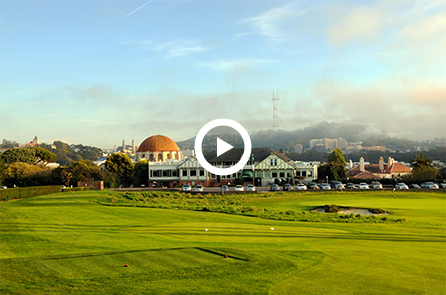
About Presidio Golf Course

Located within a national park, San Francisco’s Presidio Golf Course is renowned for its spectacular forest setting, as well as its challenging play. Once restricted to military officers and private club members, today the 18-hole course is open to the public. Presidio G.C. offers a full service restaurant, a driving range and practice facility, and an award winning golf shop that offers the latest in golf equipment and apparel. Presidio Golf Course is a contributing feature of the Presidio’s National Historic Landmark status. It is also notable for its environmentally sensitive management practices.

The Course

God shaped this land to be a golf course. I simply followed nature.
– John Lawson, designer of the first course

Presidio Golf Course is built on a variety of terrains. Holes are constructed over a base of adobe clay, rock, sand, or a combination of all three. The early Presidio Golf Course was short, but challenging. Players were often shocked by the level of difficulty and natural obstacles. Lawson Little, stamped by Golf Magazine as the greatest match player in the game’s history, said, “I have played the best courses here and abroad, but none more enjoyable than my home course of Presidio. I learned how to strike the ball from every conceivable lie. Presidio demands accuracy, but being a long hitter, I also had to learn how to hook or fade around trees. I had the reputation of being a strong heavy-weather golfer; well, Presidio has powerful wind, rain, fog, sudden gusts, and sometimes all four on any given round.”

Environmental Sensitivity

Presidio Golf Course has been recognized as a leader in environmentally sensitive golf course management, winning the 2001 “Environmental Leader in Golf Award”. Since 2000, the course has reduced overall pesticide use by approximately 50%, and currently uses approximately 75% less pesticide than private courses in San Francisco. The course also received certification from Audubon International as a partner in the Audubon Cooperative Sanctuary Program in 2003.

The course uses an innovative form of pest management and turf management called compost tea. “Compost tea” is a solution made by soaking compost in water to extract and increase the beneficial organisms present in the compost. It is then sprayed over the greens. The result is turf with longer root growth and less plant disease fungi.

Index Of Force Movie -

The film's cinematography is also noteworthy, with a muted color palette and a focus on close-ups and medium shots. This creates a sense of intimacy and claustrophobia, drawing the viewer into the complex web of relationships and power dynamics.

The film's use of symbolism is a key element of its narrative. The title "Index of Force" refers to a mathematical concept that describes the measurement of force and power. In the context of the film, the title can be seen as a metaphor for the ways in which power and control are exercised over others. The use of mirrors and reflections is also a recurring motif, symbolizing the ways in which characters reflect and internalize the power dynamics around them.

"Index of Force" is a thought-provoking and visually stunning film that explores the complex dynamics of power, control, and masculinity. The film's use of symbolism, cinematic techniques, and non-linear narrative structure creates a sense of disorientation and confusion, mirroring the complex emotions and power dynamics on screen. The film's exploration of toxic masculinity and the blurring of boundaries is particularly noteworthy, making it a relevant and timely contribution to contemporary debates about power and consent. Overall, "Index of Force" is a bold and challenging film that rewards close attention and reflection. index of force movie

One of the primary themes of "Index of Force" is the exploration of masculinity and power. The film critiques traditional notions of masculinity, highlighting the ways in which men use power and control to assert their dominance over others. Patrick, the older and more powerful man, embodies a form of toxic masculinity, using his wealth and influence to manipulate those around him. Ray, on the other hand, is drawn into Patrick's world, becoming embroiled in a complex dance of power and control.

However, some critics have noted that the film's non-linear narrative structure can be disorienting, and that the film's themes and symbolism may not be immediately accessible to all viewers. Nevertheless, the film's complexity and nuance are a key part of its appeal, making it a rich and rewarding watch for those willing to engage with its themes and ideas. The film's cinematography is also noteworthy, with a

The film also explores the theme of consent and coercion. Ray's relationship with Patrick is marked by a blurring of boundaries, with Patrick using his power and influence to push Ray into situations that make him uncomfortable. This raises important questions about the nature of consent and how it can be manipulated or coerced.

The movie follows the story of Ray (played by Daniel Sharman), a young and charismatic artist who becomes involved with Patrick (played by James Purefoy), a wealthy and influential man. As their relationship deepens, Ray becomes increasingly entangled in Patrick's world, which is marked by a complex web of power dynamics, control, and manipulation. The film's narrative is non-linear, jumping back and forth in time, which adds to the sense of disorientation and confusion. The title "Index of Force" refers to a

The film's use of cinematic techniques is highly effective in creating a sense of disorientation and confusion. The non-linear narrative structure, which jumps back and forth in time, adds to the sense of disorientation, mirroring Ray's own confusion and disorientation. The use of handheld camera work and natural lighting creates a sense of realism and immediacy, drawing the viewer into the world of the film.

Presidio Golf Course, A National Historic Landmark

A National Historic Landmark Since 1962

Originally designed by Robert Wood Johnstone, the golf course was expanded in 1910 by Johnstone in collaboration with Wiliam McEwan, and redesigned and lengthened in 1921 by the British firm of Fowler & Simpson.

LEARN MORE

The film's cinematography is also noteworthy, with a muted color palette and a focus on close-ups and medium shots. This creates a sense of intimacy and claustrophobia, drawing the viewer into the complex web of relationships and power dynamics.

The film's use of symbolism is a key element of its narrative. The title "Index of Force" refers to a mathematical concept that describes the measurement of force and power. In the context of the film, the title can be seen as a metaphor for the ways in which power and control are exercised over others. The use of mirrors and reflections is also a recurring motif, symbolizing the ways in which characters reflect and internalize the power dynamics around them.

"Index of Force" is a thought-provoking and visually stunning film that explores the complex dynamics of power, control, and masculinity. The film's use of symbolism, cinematic techniques, and non-linear narrative structure creates a sense of disorientation and confusion, mirroring the complex emotions and power dynamics on screen. The film's exploration of toxic masculinity and the blurring of boundaries is particularly noteworthy, making it a relevant and timely contribution to contemporary debates about power and consent. Overall, "Index of Force" is a bold and challenging film that rewards close attention and reflection.

One of the primary themes of "Index of Force" is the exploration of masculinity and power. The film critiques traditional notions of masculinity, highlighting the ways in which men use power and control to assert their dominance over others. Patrick, the older and more powerful man, embodies a form of toxic masculinity, using his wealth and influence to manipulate those around him. Ray, on the other hand, is drawn into Patrick's world, becoming embroiled in a complex dance of power and control.

However, some critics have noted that the film's non-linear narrative structure can be disorienting, and that the film's themes and symbolism may not be immediately accessible to all viewers. Nevertheless, the film's complexity and nuance are a key part of its appeal, making it a rich and rewarding watch for those willing to engage with its themes and ideas.

The film also explores the theme of consent and coercion. Ray's relationship with Patrick is marked by a blurring of boundaries, with Patrick using his power and influence to push Ray into situations that make him uncomfortable. This raises important questions about the nature of consent and how it can be manipulated or coerced.

The movie follows the story of Ray (played by Daniel Sharman), a young and charismatic artist who becomes involved with Patrick (played by James Purefoy), a wealthy and influential man. As their relationship deepens, Ray becomes increasingly entangled in Patrick's world, which is marked by a complex web of power dynamics, control, and manipulation. The film's narrative is non-linear, jumping back and forth in time, which adds to the sense of disorientation and confusion.

The film's use of cinematic techniques is highly effective in creating a sense of disorientation and confusion. The non-linear narrative structure, which jumps back and forth in time, adds to the sense of disorientation, mirroring Ray's own confusion and disorientation. The use of handheld camera work and natural lighting creates a sense of realism and immediacy, drawing the viewer into the world of the film.

index of force movie
Processing...
Thank you! Your subscription has been confirmed. You'll hear from us soon.
EMAIL SPECIALS
Join our email specials list to get our Weekly Update newsletter and occasional other specials and event announcements!
ErrorHere