

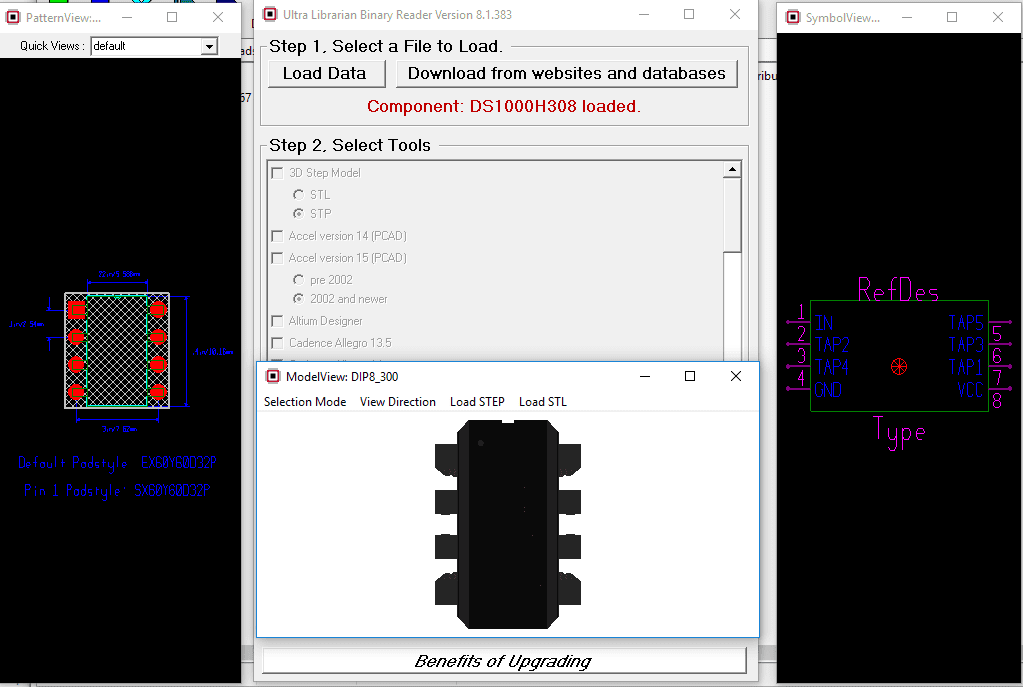
CREATE SYMBOLS, FOOTPRINTS, AND 3D MODELS FROM PRE-AUTHORED DATA

ULTRA LIBRARIAN FREE READER

Preview models prior to downloading

Choose from over 20 different CAD export options

uzbek seks ru
CONVERT BXL FILES INTO YOUR PREFERRED CAD FORMAT

The free reader is a lite version of Ultra Librarian specifically designed to import vendor neutral CAD data (.bxl files) from manufacturers’ websites and then export symbols, footprints, and 3D models to specific CAD tool formats. The reader is a read-only tool and will not allow users to make any changes to the data. For symbols, footprints, and 3D model creation capabilities, use one of the Ultra Librarian Desktop Software options.

BXL FILES FROM YOUR FAVORITE IC MANUFACTURERS

Many of our IC partners offer BXL files for their components directly on their websites. Once you have obtained a BXL file it is quick and easy to convert to your preferred CAD format through our online BXL conversion tool.

Check out all manufacturers here.

EXPORT TO OVER 30 DIFFERENT CAD FORMATS

VENDOR NEUTRAL FILES

Accel EDA 14 & 15

  • DesignSpark
  • Mentor Graphics
  • BoardStation
  • Mentor Graphics Design Architect
  • Mentor Graphics Design
  • Expedition 99 and 2000
  • PCAD 2000, 2001, 2002, 2004, and 2006
  • STL
  • TARGET 3001!
  • View Logic ViewDraw
  • Zuken CadStar 3 and 4
  • Zuken CR-5000 and CR-8000

FREQUENTLY ASKED QUESTIONS

A .BXL file contains electronic data created by Ultra Librarian in a universal format and is used for distributing PCB information. .BXL files can be opened by the Ultra Librarian Free Reader and translated into your choice of 22 different CAD formats.

Ultra Librarian has partnered with major IC manufacturers to create electronic data representing their parts and are available to the public. Partners include Analog Devices, Texas Instruments, Microchip, Maxim, Silicon Labs, Renesas, Exar, and NXP.

Yes, you can use our Online Reader if you don’t want to download the Free Reader

Free Reader

"*" indicates required fields

Dilnoza's daily routine often took her to the university's Russian Center, where she met with her language exchange partner, a Russian student named Kirill. The two had met through a cultural exchange program aimed at strengthening ties between Uzbekistan and Russia. Kirill, a 25-year-old from Moscow, was pursuing a master's degree in international relations.

Their conversations often touched on social issues, such as the role of women in Uzbek society. Dilnoza shared her experiences growing up in a conservative family, where expectations for her future were shaped by traditional norms. "Many Uzbek women face limited choices," she said. "They're encouraged to prioritize family over education and career."

Dilnoza and Kirill watched from a distance, observing the police presence and the tensions between the protesters and authorities. "This is a crucial issue for Uzbekistan," Kirill said. "The cotton industry is vital to the country's economy, but not at the expense of workers' rights."

Their discussion concluded with a sense of hope and mutual understanding. Despite the complexities and differences between their cultures, Dilnoza and Kirill had forged a strong bond, built on shared values of empathy, respect, and a desire for positive change.

As they sipped tea and practiced each other's languages, Dilnoza and Kirill discussed everything from politics to pop culture. Dilnoza confided in Kirill about her concerns regarding Uzbekistan's economic dependence on Russia. "Sometimes I feel like we're just a satellite country," she said, her voice barely above a whisper. "I want our country to be more independent, to have its own voice."

In the heart of Uzbekistan, the ancient city of Samarkand pulsed with life. Its Registan Square, once a gathering place for traders and travelers on the Silk Road, now buzzed with the chatter of students, tourists, and locals. Among them was 22-year-old Dilnoza, a bright and ambitious Uzbek woman studying at the Samarkand State University.

Dilnoza nodded in agreement. "As a society, we need to prioritize social justice and human rights. It's time for Uzbekistan to modernize its labor laws and practices."

As the sun began to set, casting a golden glow over the city, Dilnoza and Kirill decided to join a nearby traditional Uzbek teahouse. Over steaming cups of green tea, they continued their conversation, exploring the nuances of Uzbek-Russian relations and the challenges facing their respective societies.

the pcb design, assembly, and trends blog

RELATED CONTENT

Seks Ru | Uzbek

Dilnoza's daily routine often took her to the university's Russian Center, where she met with her language exchange partner, a Russian student named Kirill. The two had met through a cultural exchange program aimed at strengthening ties between Uzbekistan and Russia. Kirill, a 25-year-old from Moscow, was pursuing a master's degree in international relations.

Their conversations often touched on social issues, such as the role of women in Uzbek society. Dilnoza shared her experiences growing up in a conservative family, where expectations for her future were shaped by traditional norms. "Many Uzbek women face limited choices," she said. "They're encouraged to prioritize family over education and career."

Dilnoza and Kirill watched from a distance, observing the police presence and the tensions between the protesters and authorities. "This is a crucial issue for Uzbekistan," Kirill said. "The cotton industry is vital to the country's economy, but not at the expense of workers' rights." uzbek seks ru

Their discussion concluded with a sense of hope and mutual understanding. Despite the complexities and differences between their cultures, Dilnoza and Kirill had forged a strong bond, built on shared values of empathy, respect, and a desire for positive change.

As they sipped tea and practiced each other's languages, Dilnoza and Kirill discussed everything from politics to pop culture. Dilnoza confided in Kirill about her concerns regarding Uzbekistan's economic dependence on Russia. "Sometimes I feel like we're just a satellite country," she said, her voice barely above a whisper. "I want our country to be more independent, to have its own voice." Dilnoza's daily routine often took her to the

In the heart of Uzbekistan, the ancient city of Samarkand pulsed with life. Its Registan Square, once a gathering place for traders and travelers on the Silk Road, now buzzed with the chatter of students, tourists, and locals. Among them was 22-year-old Dilnoza, a bright and ambitious Uzbek woman studying at the Samarkand State University.

Dilnoza nodded in agreement. "As a society, we need to prioritize social justice and human rights. It's time for Uzbekistan to modernize its labor laws and practices." Their conversations often touched on social issues, such

As the sun began to set, casting a golden glow over the city, Dilnoza and Kirill decided to join a nearby traditional Uzbek teahouse. Over steaming cups of green tea, they continued their conversation, exploring the nuances of Uzbek-Russian relations and the challenges facing their respective societies.